
Alabama’s medical cannabis rules prohibit “food products like cookies or candies.” They also explicitly permit “gelatinous cubes.”

Not that kind of gelatinous cube. (Paramount, Dungeons & Dragons: Honor Among Thieves, 2023)
A gelatinous cube, in the actual regulatory language, is a gummy. It’s a cube of flavored gelatin containing a measured dose of cannabinoids. Alabama banned candy, then invented a clinical-sounding name for one specific type of candy, then permitted it. That tells you everything about what kind of market opens on May 4.
The whole legal product list reads like this. Gelatinous cubes, lozenges, tablets, capsules, tinctures, topicals, suppositories, patches, nebulizers, and inhaler oils. Every item is either pharma pretending to be cannabis or cannabis pretending to be pharma. You cannot buy flower. You cannot buy a vape pen, though you can buy an “inhaler oil” that functions as one. You cannot buy a gummy, unless it’s a cube.
This is fine. It’s fine. Every state legalization process produces one of these regulatory fictions. Alabama’s happens to be especially on-brand.
The five-year saga, speedrun edition
Alabama passed its medical cannabis bill in 2021. It was supposed to launch in 2022. It didn’t.
In 2023, the state’s regulatory commission paused licensing because somebody noticed the scoring math was wrong. There were lawsuits. There were do-overs. There were more lawsuits. A state audit this year turned up five separate compliance problems at the commission, including records-retention issues, Open Meetings Act violations, a contract overpayment, and a card-reporting rule that actually conflicted with the statute it was supposed to implement.
Three of four dispensary licenses finally issued in January. The fourth is still stayed. The first store, Callie’s Apothecary in Montgomery, plans to serve its first patient on May 4.
If you’d told me in 2021 that legal cannabis would arrive in Alabama before it arrived in North Carolina, I’d have laughed. And yet.
What Mississippi tells us Alabama just banned
Here’s where the regulatory fiction matters. If you want to know what demand looks like in a comparable Southern medical market, you look at Mississippi. Same region, same demographics, medical-only, launched 2023.
Daily sales mix at the top-performing Mississippi medical dispensary, per our Headset tracking:
Flower: 60%
Vape: 16%
Edibles: 15%
Pre-rolls: 5%
Concentrates: 3%
Everything else: ~1%
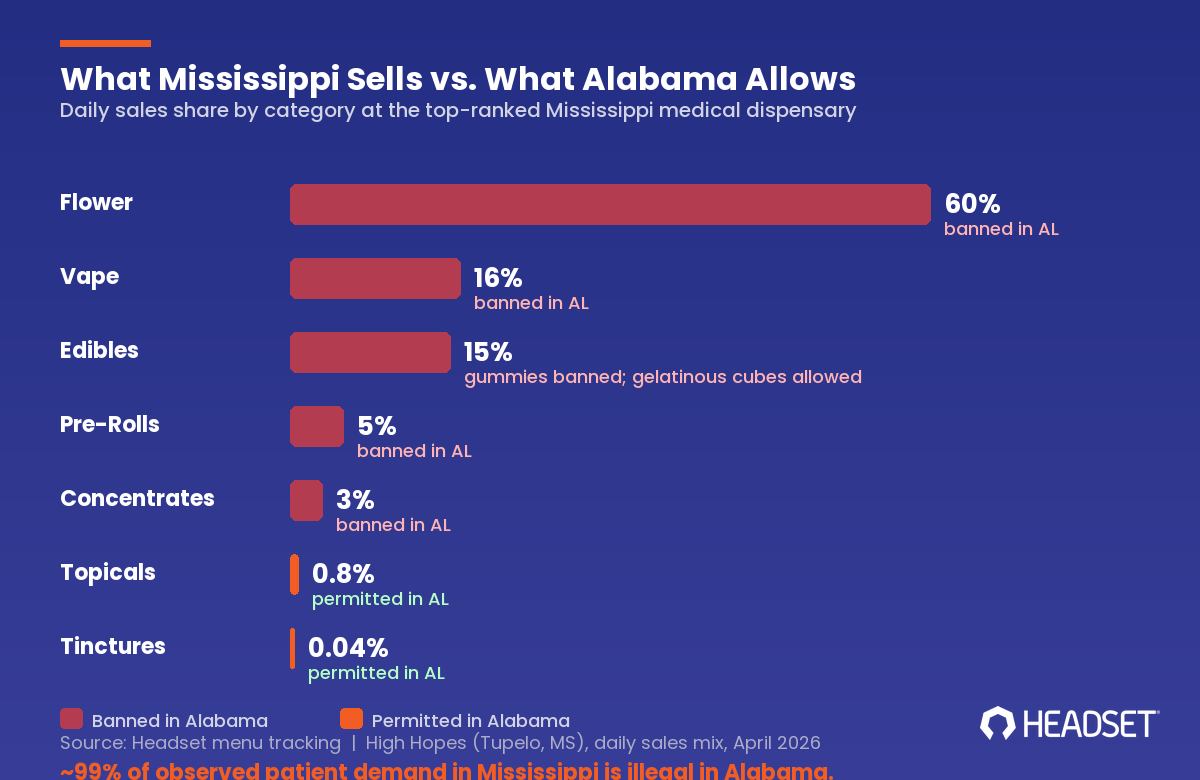
Flower is banned in Alabama. Vape is banned. Pre-rolls and concentrates are banned. Most edibles are banned, except the gelatinous-cube carve-out, which in practice is a narrow sub-slice of the edible category, maybe a third of it.
Add it up generously, and Alabama’s legal product menu maps to somewhere around 5 to 8 percent of observed patient demand in the nearest comparable state. Ninety percent of what Mississippi patients actually buy is illegal in Alabama.
This isn’t a cannabis market the way Mississippi is a cannabis market. It’s a pharmacy that happens to carry one percent cannabinoids. The question isn’t whether Alabama patients will buy what’s on the menu. It’s whether they’ll show up at all.
The 16-physician problem
Which gets to the other number that tells you what’s about to happen.
As of April 8, Alabama’s posted list of certifying physicians had 16 names on it. Sixteen. For five million people.
Mississippi ended 2025 with 259 certifying practitioners. Arkansas has hundreds. Alabama is about to open dispensaries to a patient population that mostly doesn’t exist yet, because the doctors who certify that patient population mostly don’t exist yet. You could license every retail store in the state and it wouldn’t matter. The entire physician roster would fit on a Southwest flight with seats to spare.
This is the real bottleneck. The dispensary rollout is just the part of it you can see.
How big does this actually get
Napkin math. If Alabama hits 0.3% to 0.6% of residents in the first couple years, which is well below what Mississippi (2.2%) or Arkansas (3.8%) pulled off, you’re looking at 15,600 to 31,200 active patients. At $1,600 to $2,200 annual spend per patient, which is a generous read given the product restrictions, that’s $25M to $69M a year.
Longer run, maybe $80M to $115M if the doctor roster grows and the product rules loosen. It’s a real market. It’s also about 5% the size of Florida’s medical program.
Worth building in. Not worth anchoring your entire Southern expansion thesis to.
The states that still have nothing
The list of states with zero operational cannabis program got shorter this year. It’s now down to three:
Idaho. No medical, no decrim. The state senate has been actively trying to keep a 2026 ballot initiative off the ballot.
Kansas. Zero-THC CBD only, which is not a program. It’s a vibe.
Nebraska. Voters passed medical in November 2024. Implementation has been stuck in court for more than a year. Law exists, market doesn’t.
Another six states have narrow CBD or low-THC-only programs that don’t really count as patient markets: Wyoming, Wisconsin, Tennessee, North Carolina, South Carolina, and Georgia. Georgia technically has low-THC oil on paper. In practice, access is closer to Kansas than to Mississippi.
Our online menu-tracking data gives you a rough sense of what “has a market” actually means at ground level. Tracked dispensary footprints in the South right now: Florida 717, Oklahoma 472, Mississippi 165, Arkansas 38, Louisiana 30, Georgia 24, Texas 22, Kentucky 8. Alabama opens with 3. North Carolina and South Carolina have 1 each, and those aren’t dispensaries in any functional sense.
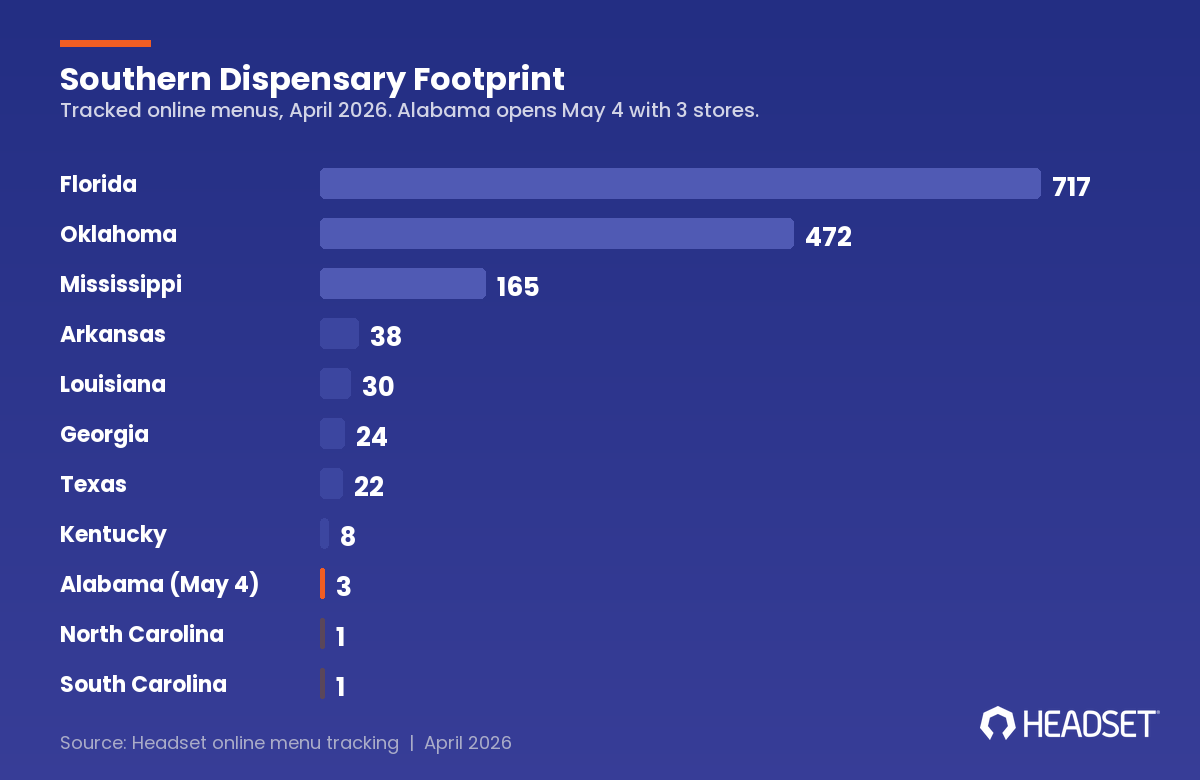
That’s nine states where the cannabis story has essentially not started. Alabama just stepped off that list.
The bet
Alabama isn’t going to be a billion-dollar market. The product rules won’t allow it. The doctor math won’t allow it. It’s going to be a small, tightly controlled, medically framed program, and whether it reaches patients in any real number depends on whether those 16 physicians become 160 in the next 12 months.
But May 4 matters more than the size. If a deep-red Southern state can stand up a functioning cannabis program, even one that bans candy and legalizes gelatinous cubes, the pitch to Tennessee and the Carolinas gets easier. If it can’t, the region stalls for another five years and Nebraska keeps all the cannabis lawyers.
I’ll be watching. If anybody picks up a gelatinous cube on opening day, send me a photo.